

ICON Case Study: How We Treated a Childhood White Spot Without Veneers
A noticeable white mark on a front tooth can affect how you feel about smiling for decades. For one of our patients at Siha Dental in Shepherd’s Bush, that’s exactly what happened. She had grown up with a very visible white lesion on her upper left central incisor and although she’d been told elsewhere that veneers or crowns might be needed, she came to us looking for a more conservative answer.
This case study walks through exactly how we treated her smile using a combination of ICON resin infiltration, Enlighten teeth whitening and a very thin layer of composite bonding with no drilling and no shaving down of her natural tooth. It’s a great example of how modern, minimally invasive cosmetic dentistry can deliver beautiful results while preserving the healthy tooth structure you already have.

The patient’s story: a white mark she’d lived with since childhood
Our patient first noticed the white mark on her upper front tooth as a child, and it had bothered her ever since. She told us it had always affected her confidence when smiling, especially in photographs.
She found Siha Dental online while specifically searching for a minimally invasive way to treat the lesion. She’d already done her research and come across ICON white spot treatment, and was drawn to our practice because of our reputation for ICON cases and conservative, holistic cosmetic dentistry in West London.
Before coming to us, she had been advised by another clinic that crowns or porcelain veneers might be the only way to fully mask the mark. Understandably, she wanted to avoid anything that involved drilling down healthy tooth structure if a less invasive option existed.
Initial assessment and clinical findings
At her consultation, we took time to understand exactly what bothered her, how long the lesion had been present and what kind of result she was hoping for. We carried out a full cosmetic assessment, including:
- Detailed clinical photographs
- Shade assessment
- A thorough clinical examination
- A brief oral health screen to check overall gum and tooth health
That oral health screen is something we never skip. Before we start any cosmetic treatment whether that’s whitening, ICON or composite bonding, we need to be confident the teeth and gums are healthy and stable. Beautiful cosmetic dentistry is always built on a healthy foundation.
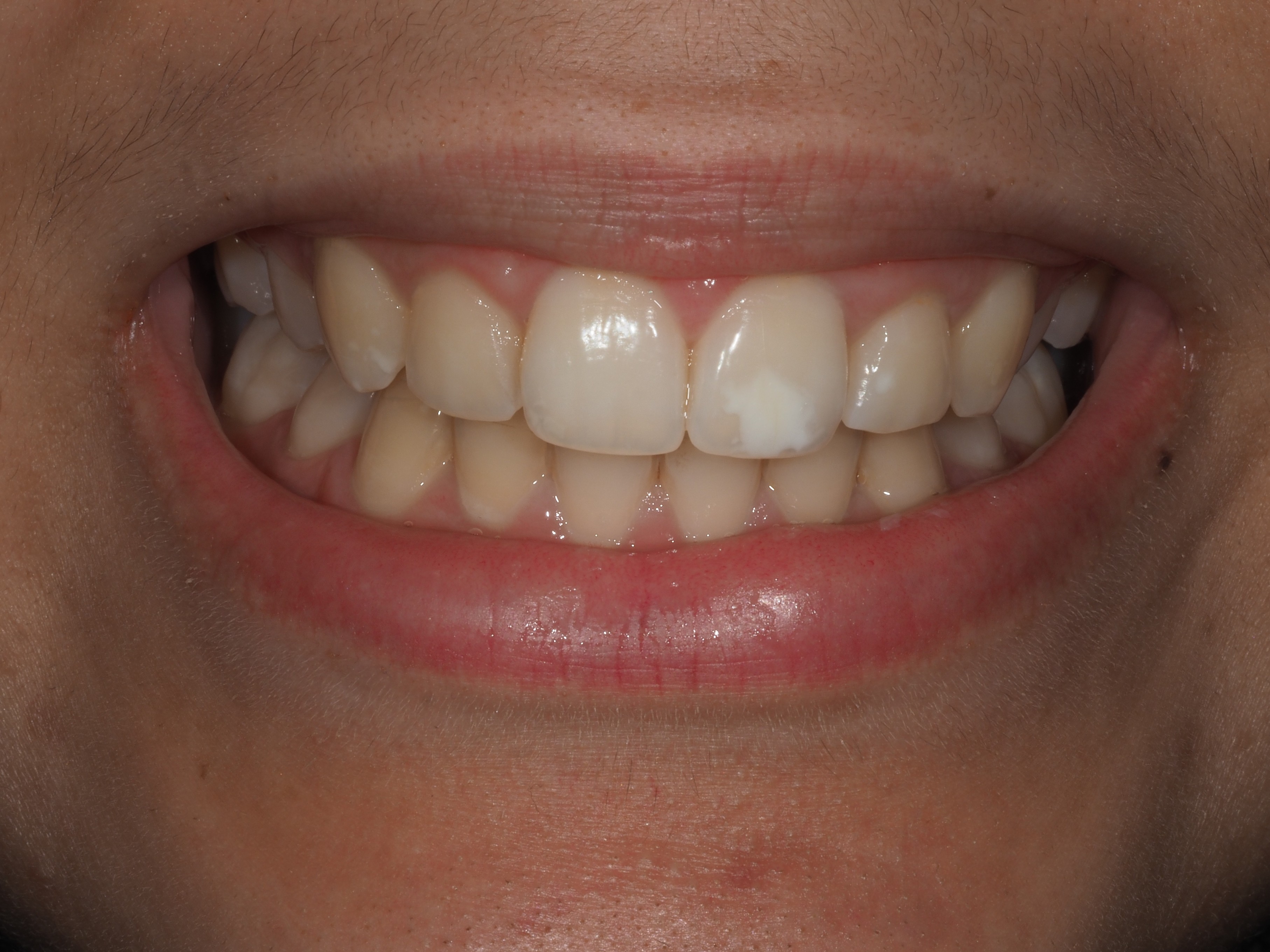
On examination, we found a deep white lesion affecting the upper left central incisor, along with smaller white areas on the adjacent teeth. The appearance was consistent with enamel hypoplasia.
What is enamel hypoplasia?
Enamel hypoplasia is a developmental enamel defect. In simple terms, it means part of the enamel didn’t form normally while the adult tooth was developing.
In this case, the most likely cause was trauma to the baby tooth during early childhood. When a baby tooth is knocked or injured, it can affect the adult tooth developing underneath it. The adult front teeth begin forming very early in life, so any injury during this period can leave a permanent mark or defect in the enamel of the adult tooth that eventually erupts.
Enamel hypoplasia can show up as a white, yellow, brown or chalky patch. The deeper and more opaque the lesion is, the harder it can be to fully mask with ICON alone which is exactly why a combination approach was the right call here.
Why we recommended Enlighten whitening first
Because the underlying shade of the patient’s natural teeth was slightly warmer and yellower, we recommended starting with Enlighten teeth whitening. This was the most conservative possible first step.
Whitening lifts the base shade of the surrounding teeth, which reduces the contrast between the white lesion and the rest of the smile. The goal isn’t just to make the teeth whiter it’s to create a better foundation so the lesion is easier to treat predictably.
We use Enlighten because it is one of the most predictable whitening systems available and is designed to achieve reliable, even results with minimal sensitivity when used correctly.
It’s important to know that during whitening, white spots can initially appear brighter. This is completely normal. After whitening finishes, the colour usually settles over around 7–10 days, and the overall tooth shade balances. The white lesion is still visible at this point, but the contrast is softer and more manageable for ICON.
The ICON treatment: minimally invasive resin infiltration
Once the whitening had fully settled, we carried out ICON resin infiltration in a single appointment. ICON works by treating the porous, abnormal enamel structure inside the white lesion itself, rather than by drilling it away.
There are two key stages:
- ICON etchant gel is applied to the affected enamel. This opens up and prepares the hypoplastic enamel so it can better receive the resin.
- ICON resin infiltrant is then applied. The resin penetrates the porous structure and changes the way light passes through the lesion. By altering the optical properties of the white spot, the area blends far more naturally with the surrounding enamel.
ICON is genuinely minimally invasive. Unlike veneers or crowns, it doesn’t involve drilling away healthy tooth tissue. It’s especially well suited to white spot lesions, early enamel defects and certain hypoplastic marks where the enamel surface can be improved without aggressive intervention.
If you’d like a fuller explanation of how the treatment works, we’ve also written a more general guide to ICON white spot removal in West London.
Why we added a small amount of composite bonding
Because this particular lesion was deep and well established, we knew from the start that ICON alone was unlikely to mask it completely. This is something we see often with deeper hypoplastic lesions and it’s why a combination approach so frequently delivers the most natural-looking result.
To refine the outcome, we placed a very thin layer of composite resin over the treated area. The composite was carefully shade-matched to her newly whitened natural tooth colour, allowing us to create a smoother, more seamless finish.
The crucial point here is that this was not a full veneer. There was no aggressive drilling or shaving down of the tooth. It was a very conservative addition designed to enhance the final aesthetic result while preserving as much natural tooth structure as possible.
The final result: natural, bright and conservative
The final outcome was natural, bright and minimally invasive. The large white lesion that had bothered our patient for most of her life was significantly improved, and the tooth blended much more harmoniously with the rest of her smile.
She was delighted with the result, particularly because we’d been able to avoid crowns and porcelain veneers entirely. This case is a really clear example of how modern, minimally invasive cosmetic dentistry can produce beautiful, confidence-boosting results without unnecessarily cutting down healthy teeth.
How to maintain results long-term
One of the things we’re most proud of at Siha Dental is the long-term care we offer our patients. Maintaining a result like this is straightforward, but it does need a small amount of ongoing attention. Here’s what we recommended for this case:
- Whitening top-ups at home: Around four hours once a month is usually enough to keep the overall tooth shade stable for years to come.
- Regular hygiene visits: Composite can pick up surface staining over time. Regular cleaning with our dental hygienist, including airflow polishing where appropriate, keeps everything looking clean and fresh.
- Annual composite polish: We polish composite bonding as part of routine oral health assessments, usually once a year. We offer this complimentary to our patients.
- Long-term composite review: On average, composite may start to look slightly duller or yellower compared with natural teeth after around 5–7 years. When the time comes, it can be carefully refreshed or replaced under high magnification to protect the natural tooth underneath.
Why patients choose Siha Dental for ICON treatment in West London
At our Shepherd’s Bush practice, our philosophy is to protect and enhance your natural smile with as little intervention as possible. This case reflects exactly that approach: we treat the underlying issue with the most conservative tool available first, and only add to it where genuinely needed for the best aesthetic result.
Patients in Shepherd’s Bush, Hammersmith, Acton, Chiswick and across West London come to us because we offer:
- An award-winning team led by Dr Hannan, with extensive experience in minimally invasive cosmetic dentistry
- A holistic, prevention-led approach to oral health and aesthetics
- Honest, transparent treatment planning including being upfront when a simpler option will give you a great result
- Advanced diagnostic imaging for accurate, predictable cosmetic outcomes
- A calm, spa-inspired clinic environment designed to put nervous patients at ease
Frequently asked questions about ICON, whitening and composite bonding
Can all white spots be treated with ICON alone?
Not always. Shallow white lesions, post-orthodontic marks and mild fluorosis often respond beautifully to ICON on its own. Deeper, more established hypoplastic lesions like the one in this case, sometimes need a combination of whitening, ICON and a small amount of composite to achieve the most natural result.
Is ICON treatment painful?
No. ICON doesn’t involve any drilling or injections, so most patients feel nothing at all during the procedure. It’s one of the most comfortable cosmetic treatments we offer.
Why did we recommend whitening before ICON?
Whitening lifts the overall shade of the natural teeth, which reduces the contrast between the white lesion and the surrounding enamel. It also gives us a brighter, more uniform base to match any composite to, leading to a much more seamless final result.
Is composite bonding the same as a veneer?
No. Composite bonding involves carefully sculpting a tooth-coloured resin onto the surface of the tooth, typically with little or no drilling. Veneers, by contrast, usually require some preparation of the natural tooth and are made in a laboratory. In this case, only a very thin layer of composite was added, far less than would be removed for a traditional veneer.
How long does the whole treatment take?
Enlighten whitening usually takes around 2–3 weeks of home wear combined with a final in-practice session. ICON is completed in a single 60–90 minute appointment after whitening has settled. Composite bonding is added in the same visit or a follow-up appointment, depending on the case.
How long will the results last?
With good care, ICON results can last for many years and can be safely repeated in future if needed. Whitening can be maintained with monthly top-ups at home. Composite bonding typically lasts around 5–7 years before it benefits from refreshing or replacement, something we can do conservatively to protect the natural tooth underneath.
Could veneers or crowns have been a better option?
In this case, no. Veneers and crowns require significant removal of healthy tooth structure, which is irreversible. Because the patient was a great candidate for a minimally invasive approach, we were able to achieve a beautiful result while keeping her natural tooth almost completely intact, which is always our preference where clinically possible.
Considering ICON treatment in West London? Book a free consultation
If you’ve been self-conscious about a white mark, brown spot or enamel defect on your front teeth and especially if you’ve been told the only option is veneers or crowns, it’s worth exploring whether a minimally invasive approach could work for you.
At Siha Dental in Shepherd’s Bush, we offer free ICON consultations where we’ll assess your teeth, take clinical photographs and talk you honestly through the most conservative options for your smile.
Book your free consultation at Siha Dental today or call us on 020 4602 3510.
Tell us about yourself
We’ll get back to you within 24 hours to confirm your appointment.
Heading 1
Heading 2
Heading 3
Heading 4
Heading 5
Heading 6
Lorem ipsum dolor sit amet, consectetur adipiscing elit, sed do eiusmod tempor incididunt ut labore et dolore magna aliqua. Ut enim ad minim veniam, quis nostrud exercitation ullamco laboris nisi ut aliquip ex ea commodo consequat. Duis aute irure dolor in reprehenderit in voluptate velit esse cillum dolore eu fugiat nulla pariatur.
Block quote
Ordered list
- Item 1
- Item 2
- Item 3
Unordered list
- Item A
- Item B
- Item C
Bold text
Emphasis
Superscript
Subscript
Book your new patient consultation today
Are you ready to get started on your journey to a healthier, happier smile with Siha Dental? We’re currently taking on new patients at our West London dental practice. We look forward to welcoming you to Siha Dental and Facial for your new patient consultation.
Book your consultation today